
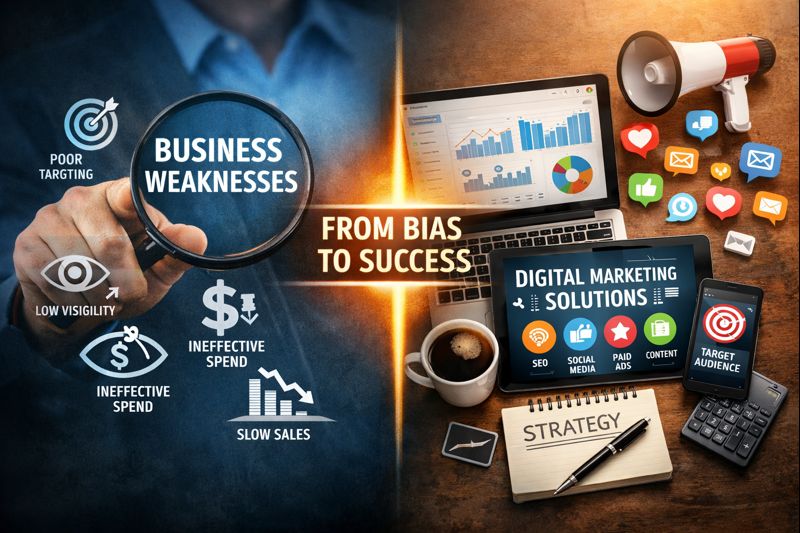
Every business wants growth, visibility, and consistent sales. Yet many companies struggle even when they offer good products or services. The reason is often not obvious. The real issue usually lies in hidden business weaknesses, especially bias in decision-making, marketing, and customer targeting.
Understanding these weaknesses and solving them strategically through digital marketing is what separates struggling businesses from successful ones.
Understanding Business Weakness and Bias
A business weakness is any internal or external factor that limits growth, reach, or profitability. One of the most common and dangerous weaknesses is bias.
Business bias occurs when decisions are based on assumptions, personal opinions, habits, or outdated beliefs instead of real customer data. Examples include:
- Targeting only one type of customer because it worked before.
- Believing word-of-mouth is enough and ignoring online marketing
- Assuming customers are not active on social media
- Promoting products without understanding customer behavior
Bias blinds businesses from reality. It creates a gap between what the business thinks customers want and what customers actually need.
Common Business Weaknesses Caused by Bias
1. Poor Customer Targeting
Many businesses market to “everyone” or the wrong audience. This happens when decisions are based on assumptions instead of research. As a result, marketing efforts fail to convert into sales.
2. Low Visibility
Some businesses believe product quality alone will bring customers. This belief leads to a weak online presence, low brand awareness, and missed opportunities in search engines and social platforms.
3. Ineffective Marketing Spend
Without data, money is spent blindly on random ads, platforms, or promotions with no clear return on investment (ROI).
4. Weak Brand Trust
When businesses focus solely on self-promotion rather than on customer value, their content feels overly sales-driven. This reduces trust and long-term loyalty.
5. Slow Growth and Declining Sales
When weaknesses are ignored, competitors who use digital tools and customer insights move ahead faster.
How Digital Marketing Identifies Business Weaknesses
Digital marketing is not just about promotion; it is also about diagnosis and solution.
Data-Driven Insights
Tools like Google Analytics, Meta Ads Manager, and Google Search Console provide real customer data. This data removes guesswork and bias by showing:
- Who your customers really are
- What they search for
- Which platforms do they use?
- What content attracts them
Customer Behavior Analysis
Digital platforms track clicks, time spent on pages, bounce rates, and conversions. These insights reveal weaknesses in messaging, website design, offers, and user experience.
Market and Competitor Analysis
Businesses can study competitors’ strategies, pricing, content, and audience engagement. This helps identify gaps and areas where improvement is needed.
1. Replacing Assumptions with Facts
How Digital Marketing Solves Bias-Related Weaknesses
SEO performance, ad results, and analytics data help businesses make decisions based on measurable outcomes, not personal opinions.
2. Accurate Audience Targeting
Digital marketing allows precise targeting based on age, location, interests, behavior, and purchase intent. This ensures marketing reaches the right people.
3. Personalized Communication
Email marketing, remarketing ads, and tailored content strategies allow businesses to move beyond one-size-fits-all messages.
4. Performance Optimization
Campaigns can be tested and improved in real time. Weak strategies are corrected quickly, reducing risk and wasted spending.
5. Building Trust Through Value
Content marketing, social media engagement, and customer reviews shift the focus from aggressive selling to customer education and relationship building.
Digital Marketing Channels That Strengthen Weak Businesses
- Search Engine Optimization (SEO): Improves visibility and brings organic, intent-based traffic.
- Social Media Marketing: Builds engagement and removes bias about where customers spend time.
- Paid Advertising: Targets high-potential audiences and reduces wasted budget.
- Content Marketing: Educates customers and establishes authority and trust.
- Analytics and Reporting: Ensures continuous improvement through measurable insights.
Real-World Impact
Businesses that adopt digital marketing strategically experience:
- Better decision-making
- Reduced bias
- Higher conversion rates
- Stronger customer relationships
- Sustainable growth
Digital marketing turns weaknesses into strengths by aligning business goals with real customer behavior.
Conclusion
Business weaknesses, especially bias, are silent growth killers. Ignoring them keeps businesses stuck in the same cycle of low visibility, poor targeting, and slow growth. Digital marketing breaks this cycle by introducing clarity, data, and strategy.
A digital marketer’s role is not just to promote a business but to identify weaknesses, remove bias, and build systems that drive measurable growth. When businesses stop guessing and start using digital marketing intelligently, success becomes predictable, not accidental.